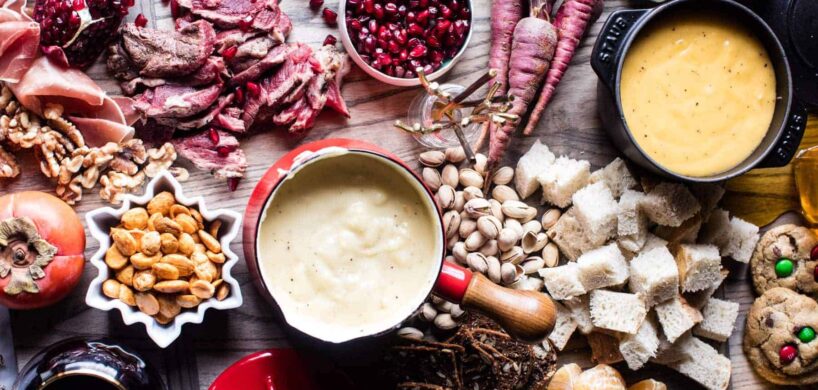
Bilbo Baggins does not hesitate when it comes to food. Thirteen dwarves and a wizard have just arrived unannounced at his home in Bag End, and within minutes Bilbo is in the pantry pulling out everything he has: seed-cakes, scones, cold chicken, pickles, a great deal of cheese. Beer from the cellar. Unlimited wine from the racks. He does not serve them because he is obligated. He serves them because he cannot, in the deep marrow of his character, do anything else when someone arrives hungry at his door. The Shire’s most fundamental social act is feeding people. The most hospitable thing a hobbit can do is lay a table and mean it. Tokien felt this himself in Switzerland during a hiking trip in 1911 when Swiss communal cheese fondue feast inspired his sense of the absolute necessity of the communal meal.
This is the story of the Hobbit’s emergence of the Hobbit’s communal feastings and how the Fondue Villa & Wykibort Washbar Hut still keep this tradition alive!
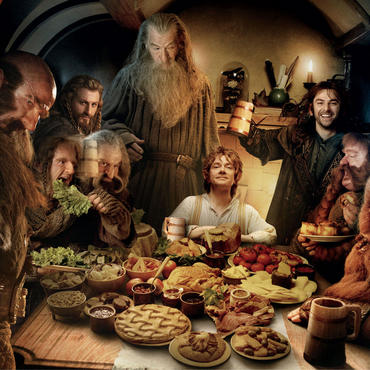
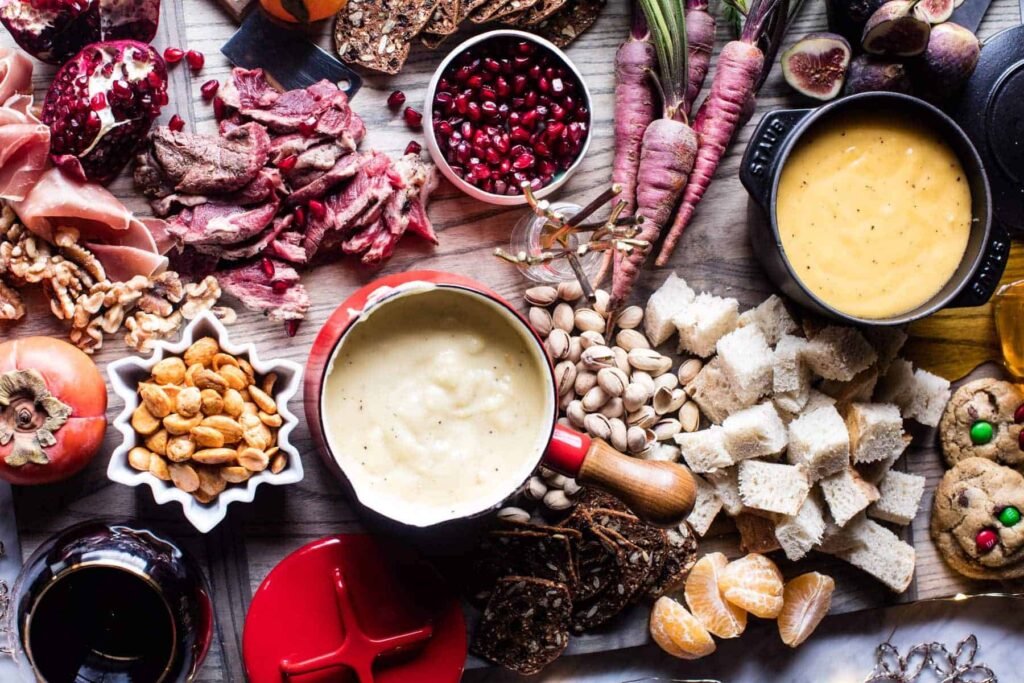
How the Hobbits came to like Swiss cheese & food
J.R.R. Tolkien wrote this from his own experience. Specifically, from an experience he had in the Bernese Oberland of Switzerland in the summer of 1911, when he was nineteen years old, walking the high Alps with eleven friends from Birmingham, sleeping in cowbyres when the inns were full, and eating the food the mountains provided: bread, hard cheese, wine when the herder had it, the fire kept burning through the night. He did not know, at the time, that he was assembling the emotional architecture of a world. He thought he was on a summer walking tour. He was doing both simultaneously as the Hobbit and Lord of the Rings Middle Earth would later prove to have been based on a lot of Swiss locations around Interlaken
Where the LOTR & Hobbit Dwarves Come From
The thirteen dwarves who arrive at Bag End in the opening pages of The Hobbit do not come from nowhere. They come, in the deepest sense, from the mountains — from the tradition of mountain folk who live in the rock, work the deep seams, and travel hard through difficult country carrying the memory of a home they have lost. Tolkien gave them names from old Germanic sources, but the living version of these figures — the dwarves as a cultural presence, as a thing that a valley actually believes in — was walking distance from where he slept in 1911.
The Haslizwerge: Swiss mountain dwarves lore
In the Haslital, the valley that opens east of Meiringen into the high Bernese Oberland, the dwarves are not mythological abstractions. They are the Haslizwerge: a specific, beloved, locally rooted presence in the folklore of this valley, documented in the old stories that the Hasli people have been telling for as long as anyone can trace the telling. The Haslizwerge are mountain dwarves in the fullest sense — small, extraordinarily skilled, living inside the rock of the high passes, emerging at night to work in ways that no ordinary craftsman could match, and retreating before dawn back into the mountain. They are not malevolent. They are, in the Hasli tradition, more complicated than that: ancient, self-contained, operating by their own rules, occasionally helpful to the humans who share their landscape if those humans know how to treat them, and deeply attached to the specific geography of this valley. They belong here. The Haslital is theirs in a way that predates any human settlement record.
Tolkien walked through Meiringen in August 1911, at nineteen, with the scholarly mind of a man who had been studying exactly this kind of material — Old Norse, Old English, Germanic mythology, the whole deep tradition of the mountain underground — and entered the Haslital corridor that opens into the Bernese Oberland beyond it. Whether he knew the Haslizwerge stories specifically is not documented. But the landscape that produced those stories surrounded him entirely: the same high passes, the same sense of deep rock inhabited by something older than the current generation of visitors, the same valley that had been generating dwarf folklore since before anyone thought to write it down. He was nineteen, and the mountains were doing something to his imagination that he would not fully account for until thirty years later. The Haslizwerge were in the rock around him whether he knew their names or not.
The dwarves in The Hobbit understand, as the Haslizwerge understand, that the communal meal is not a luxury. It is a necessity — the thing that holds a company of mountain travellers together when the journey is long and the dark is close. When Thorin and his twelve companions sit at Bilbo’s table and eat his cheese and drink his beer with the particular appetite of people who have come a very long way through difficult country, it is not greed. It is the recognition — deep in the mountain tradition, deep in the Haslital — that this is exactly what the table is for.
The Ancient Wykibort Hut & The Meadow that Fed Tolkien in 1911
On the Wengernalp meadow above the village of Wengen, at 1717 metres, there is a building. It is the oldest remaining building on the mountain. It was documented on a cadastral map of the meadow in 1864 — predating the Hotel de la Jungfrau (the current hotel Wengernalp), predating the rack railway, predating the whole infrastructure of Alpine tourism that would transform this pasture over the following decades. Its old name, preserved in local records and on that 1864 map, is the Wykibort Hütte. A cowbyre. A working Sennhütte of the kind that staffed the Alpine summer pastures for centuries before hotels existed: a place where cowherds lived during the grazing season, where milk was pressed into cheese, where the fire burned through the night, and where travellers passing through could, for a modest sum, find straw and the products of the herd.
Sleeping Cowbyres on the Wengernalp
Tolkien slept in a cowbyre on the Wengernalp in August 1911. The Wykibort Hütte is the building on this meadow of this tradition. His party was travelling on foot, spending carefully, and the cowbyre was the practical shelter for a walking tour group that was not paying hotel prices. The building that stands on this ground today — the Wycki Wäschbar (Washbar), operating as a ski slope restaurant in winter — is its inheritor in timber and time, still on the same ground, still the oldest structure on the meadow. Still made of the same wooden logs it was made of when Tolkien visited the Wengernalp and gazed at the Celebdil mountain of his dreams!
The meal in the Wykibort Hut that night would have been this: cheese cut from a wheel melted in a cauldron on an open fire hearth, dense bread, wine from the valley below. Twelve young men and a teacher, exhausted from the day’s walking, eating in the firelight with the Jungfrau massif somewhere in the darkness outside the door. Tolkien had just had a few brutal long mountainous hiking days. He had for the first time seen mountains and hiked them. He had signed the guestbook at the Obersteinberg inn at the far end of the Lauterbrunnen valley the day before. He was hungry in the specific way that only mountain walking produces: a hunger that makes the simplest food taste like the best thing you have ever eaten. It is in this setting that the Swiss cheese fondue both was invented and tastes the best. It is here where Tolkien would have savoured it to the fullest mountain delight.
He carried that meal for thirty years as a delightful, replenishing and delicious memory. It came out as the Shire larder. It came out as the first chapter of The Hobbit: thirteen dwarves at a table, seed-cakes and very good cheese, the host flustered but feeding them anyway because that is what you do when people arrive at your door having come a long way through difficult country.
Middle-Earth’s Communal Meal & Fondue Feasts are the same
Swiss cheese fondue is the meal that the Alpine dairy farmers created to savour something delicious on the mountain with only local available ingredients: typical Bernese Alpkäse for the specific high-pasture character of these mountains — is grated and melted in dry white wine over steady heat, stirred continuously in the figure-of-eight that keeps it flowing rather than seizing, finished with Kirschwasser, and placed at the centre of the table in a pot that everyone shares. The bread is yesterday’s, cubed, the crust providing purchase for the fork. Nothing about the arrangement permits solitude. The pot is too large, the ritual too demanding, the basic requirement of sharing a single vessel too fundamental to the experience. You cannot eat fondue alone. That is not a flaw in the design. It is the point.
This is the type of meal that Tolkien’s dwarves were eating at Bag End, in the form that the Shire’s agricultural culture could produce. Cheese. Bread. Wine. The communal vessel — whether it is a fondue pot or a shared platter at Bilbo’s table is beside the point. The argument is the same: the circle of friends, the warmth from inside the group rather than from the room, the food that was made from this specific landscape by people who know how to live in it. This is what the Shire is. This is what the dwarves understood instinctively when they arrived. The table is the civilisation. Everything else — the mountains, the adventure, the dragon at the end — is undertaken in service of returning to it.
Feasting always comes first….
In The Lord of the Rings, when the Fellowship finally reaches Rivendell — the Elven valley drawn directly from the Lauterbrunnen Valley floor, with its hanging cliffs and its waterfalls, the place Tolkien had walked into in August 1911 — the first thing that happens is a feast. Not a council. Not a briefing. A feast. Long tables, wine, music, the warmth of a fire in a great hall, and the specific relief of people who have been travelling hard through dangerous country arriving somewhere that knows how to feed them properly. Tolkien understood the feast as a form of restoration, because he had experienced it: the meal in the mountain hut after the day’s exertion, the food that tastes extraordinary at altitude, the circle of friends that the darkness outside makes tighter and warmer.
The Fondue Villa: Where the Story Arrives at the Table
The Fondue Villa in Interlaken is less than 10 kilometres from the Wengernalp meadow where Tolkien slept and feasted on Swiss cheese himself. The cheese in our caquelon (fondue pot) is still that same local alpine Bernese mountain and Alpine cheese (Alpkäse) — is made from the milk of animals that graze on the same high-altitude pastures above Wengen that the Wykibort Hütte served for centuries. The bread in the basket is from the valley floor. The wine in the caquelon and in your glass is Swiss, because it should be. This is the way of the Fondue Feast.
You arrive from wherever you have come from — the Jungfrau, the Lauterbrunnen Valley floor, the Staubbach Falls, the Wengernalp meadow — and you sit down at a Fondue Villa table with the people you came with, and the pot is placed at the centre, and the evening begins. This is not a tourist performance of Swiss culture. This is Swiss culture, doing what it has always done: organising the end of a day in the mountains around the communal pot, the shared bread, the wine that warms from inside.
Tolkien walked past this exact ground on his way to the mountains that would become Middle-earth. He slept on the meadow above in a cowbyre whose successor building still stands. He ate, almost certainly, the precursor of this meal in a building that predates this town’s current incarnation. He carried it home and built a world from it. The meal he ate is still being made, in this valley, from the same ingredients, for the same reason: because people arrive here having come a long way through remarkable country, and they are hungry, and there is no better answer to hunger — in Interlaken or in the Shire — than a table, a pot, and the company of friends.
Bilbo did not hesitate. Neither should you.
Book Your Table at the Fondue Villa
The Fondue Villa is in Interlaken, two kilometres from the Wengernalp meadow where Tolkien slept in August 1911. We serve traditional Bernese fondue made with Gruyère, Emmental, and Berner Alpkäse — the cheese of these mountains, from these pastures, in this specific pot. The cheese is the same cheese. The valley is the same valley. The evening is waiting.
Reserve your table at the Fondue Villa →
After dinner, explore the full Tolkien story at Icons of Interlaken — Icon 47, J.R.R. Tolkien, The Mythmaker. The valley that built Middle-earth is also the valley that built the fondue pot. Both are still here.