Most people arrive in Interlaken with a plan involving mountains. They have booked the paragliding, researched the cable cars, printed out the Jungfraujoch timetable. What they have not planned — because they had no idea it existed — is the evening. And the evening, it turns out, is where Switzerland stops being spectacular and starts being profound. So what happens at night in Interlaken you might ask. This is a guide to the best Swiss evening available in Interlaken. It involves melted cheese and a medieval archer. It has been waiting for you for over 100 years and is the literal summit of Swissness!
First: What Is Swiss Cheese Fondue, Really about
You may think you know what fondue is. A pot of melted cheese. Something people do at ski resorts. A slightly retro dinner option.
You are about to find out that you were thinking about it wrong.
Fondue is not a dish in the way a steak or a pasta is a dish. It is a ceremony. A single pot of cheese — in Switzerland, traditionally Gruyère and Vacherin Fribourgeois, melted together with white wine and a whisper of garlic — is placed at the centre of the table over a flame. Everyone receives a long fork and a basket of bread. And then something happens that no amount of smartphone screens can replicate: everyone leans in, reaches toward the same centre, and begins to eat slowly together.
There is no option to eat quickly at a fondue table. The cheese is hot, the bread needs to be turned, and the conversation finds its own pace because the food insists on it. The Swiss have been eating this way for centuries — not because they lacked alternatives, but because they understood something about what a shared meal is actually for.
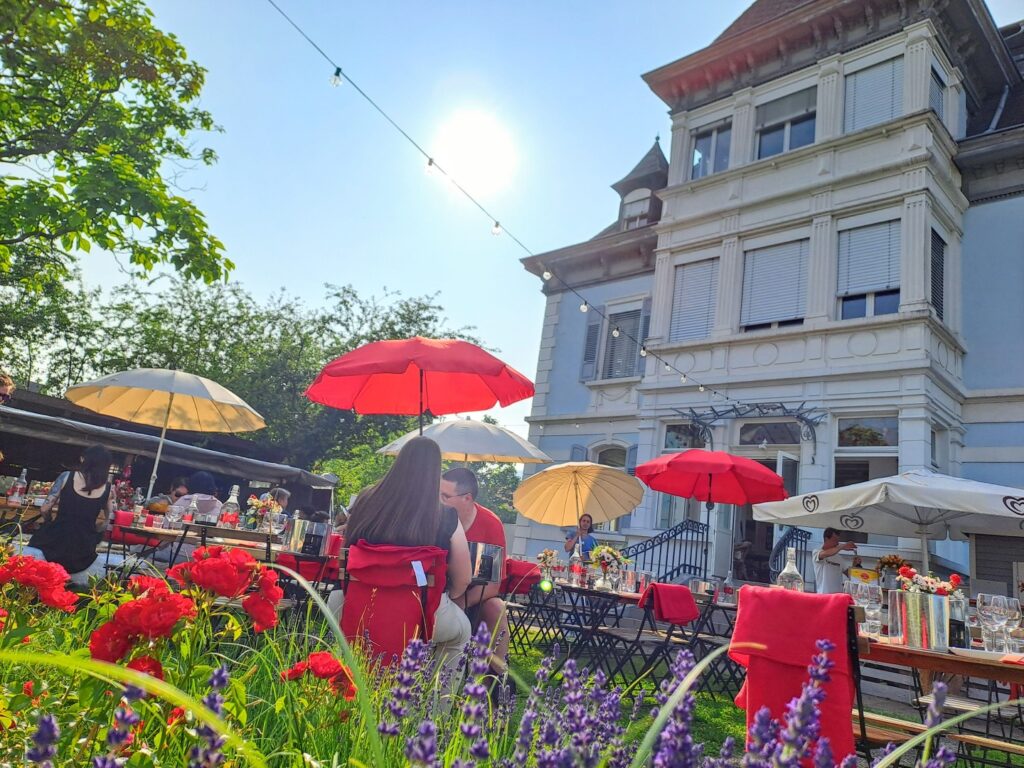
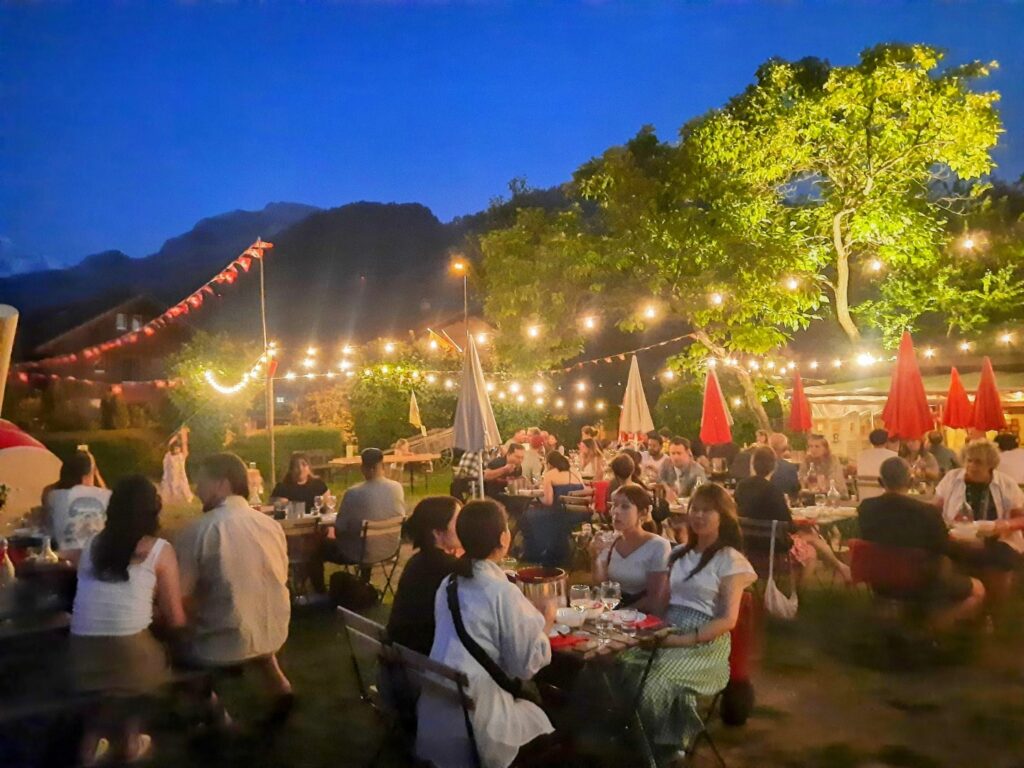
At Fondue Villa in Unterseen, a short walk from the centre of Interlaken, the fondue is made the traditional and local way. The cheese is right. The bread is right. The garden opens towards the snowcapped mountain panorama of the Eiger, Mönch & Jungfrau. An evening session runs from 17:00. By 19:00 you will have had the best meal of your trip — and you will be perfectly placed for what comes next.
Second: What and Whom Is Wilhelm Tell really
Somewhere in Switzerland in the year 1307 — or so the story goes — a man named Wilhelm Tell refused to bow his head to a tyrant’s hat.
The hat belonged to Hermann Gessler, the Habsburg governor who had been sent to impose imperial authority on the free mountain cantons of central Switzerland. Gessler placed his hat on a pole in the market square of Altdorf and commanded every passing citizen to bow before it as a symbol of submission. It was a small thing, as acts of humiliation go. Bow to a hat, and the Habsburgs own you.
Tell walked through the square with his young son. He did not bow.
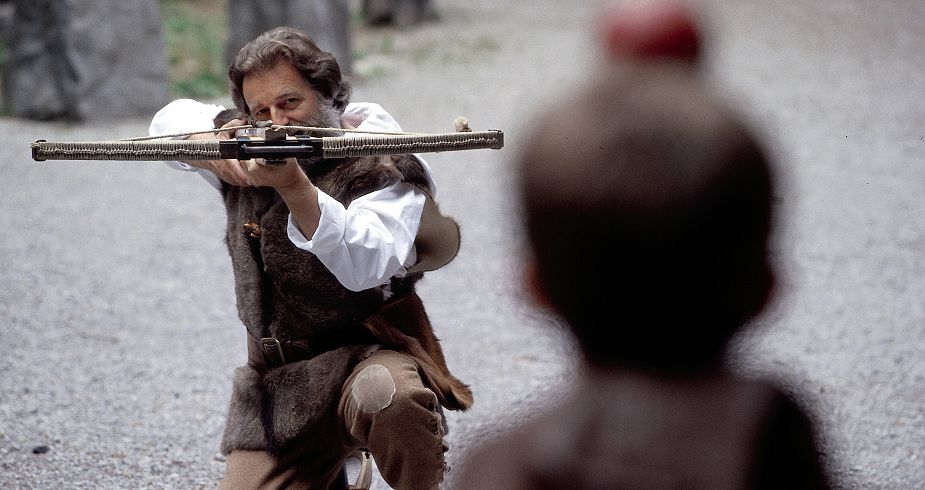
What happened next became the founding story of a nation. Gessler had Tell arrested and gave him a choice: shoot an apple from his son’s head at a distance of eighty paces — roughly the length of a swimming pool — or both would be executed. Tell was a celebrated crossbowman. He loaded his bow. He placed a second bolt in his quiver. He shot. The apple split cleanly. His son was unharmed.
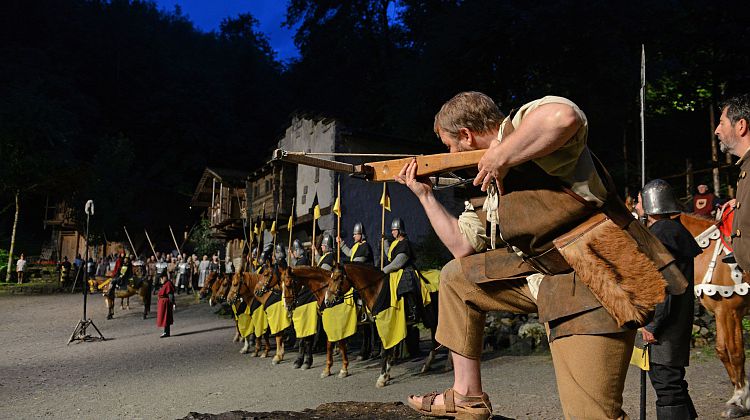
When Gessler asked about the second bolt — why had Tell pulled two — Tell told him the truth: if he had struck his son, that bolt was for you.
Gessler had Tell arrested anyway. Tell escaped, hunted Gessler down, and killed him. The act of one man’s defiance spread through the mountain cantons. The three founding regions of Switzerland — Uri, Schwyz, and Unterwalden — swore a collective oath of mutual defence on a meadow above Lake Lucerne. That oath, the Rütlischwur, is considered the founding moment of the Swiss Confederation. The date associated with it — 1 August 1291 — is Switzerland’s national day. The crossbow Tell used to split the apple appears today on every Swiss Made quality label, on Swiss watches, on Swiss pharmaceuticals, on the things Switzerland is most proud of making well.
Wilhelm Tell — known in English as William Tell — may or may not have been a real person. No historian can prove he existed. What no historian can dispute is what he became: the story Switzerland tells about itself. About what it means to refuse. About what a man owes to a power that has gone too far.
Third: The Interlaken Tellspiele, a 100-year old Open-air Theatre tradition
In 1912, a schoolteacher named August Flückiger had an idea. He would perform Tell’s story — in the forest on the edge of his village, under the actual Swiss sky, with the actual Swiss mountains behind the stage. Two thousand people came to watch the first performance on 19 May 1912 in the Rugenwald forest in Matten, a ten-minute walk from the centre of Interlaken.
That was 113 years ago. The Tellspiele has been performed every summer since — interrupted only by two world wars and a global pandemic, each time resuming when the world allowed. Over two million people have sat in that grandstand and watched a crossbow bolt fly toward an apple balanced on a child’s head.
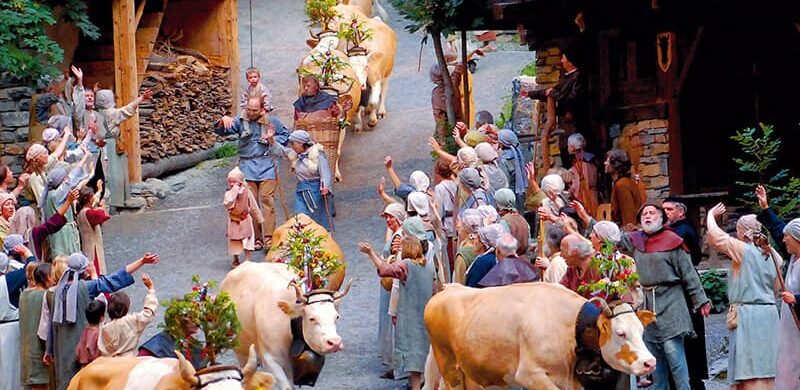
The production today involves more than 140 performers — local volunteers from Interlaken and the surrounding villages, many from families who have been performing in this same production for three and four generations. There are 18 horses. There are live goats and cattle. There is a full medieval village set — thatched farmhouses, a stone chapel, a defensive tower — that visitors can walk through before the performance begins. The stage is not a stage in any conventional sense. It is the forest. The backdrop is not painted scenery. It is the actual Rugenwald hillside, the actual trees, the actual darkness of a Swiss summer night coming in over the mountains.
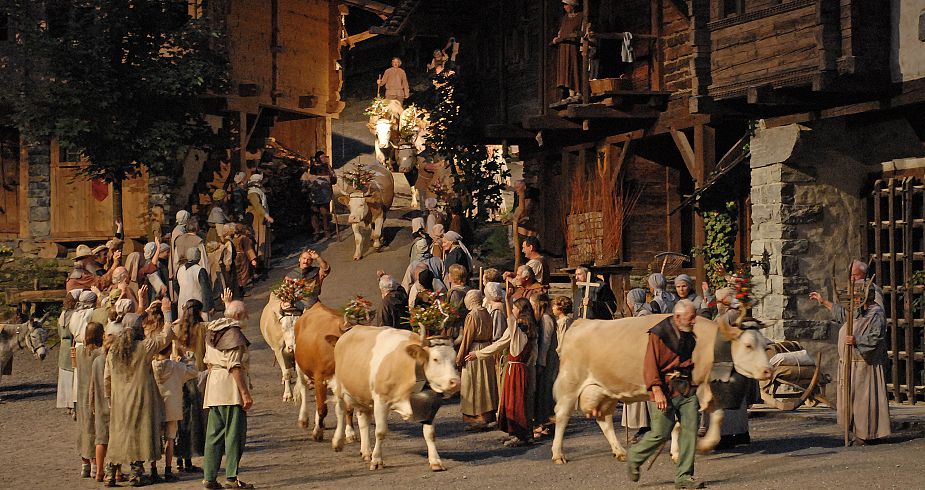
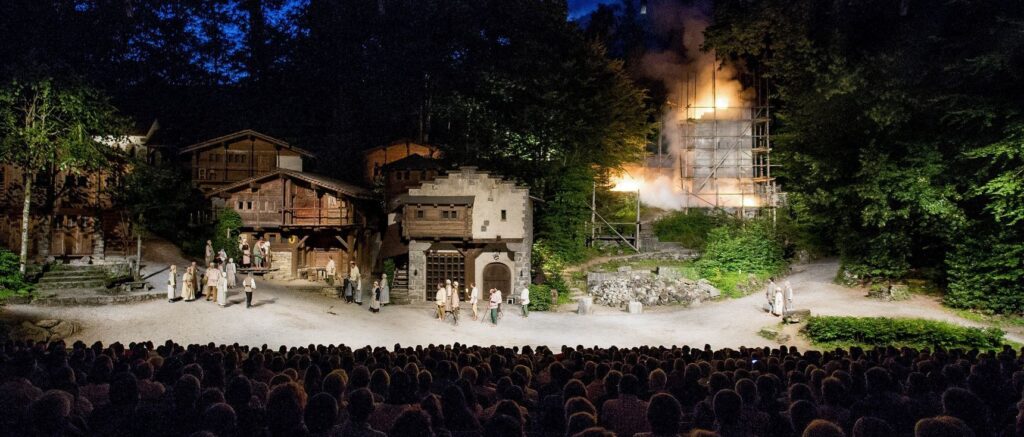
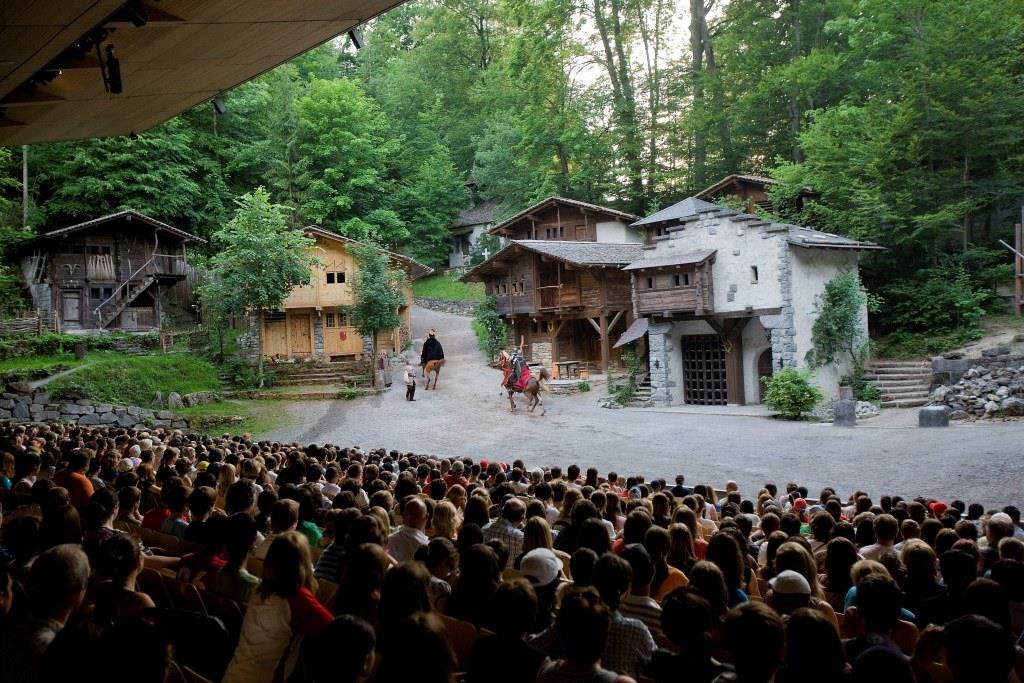
The apple shot happens in Act III. It has been happening at the same moment in the same forest for 113 years. A real crossbow. A real apple. A real child standing still. And one thousand five hundred people — strangers from every country in the world, sitting together in an outdoor grandstand in the dark — going completely silent.
That silence is something that people who have sat in it have described from different countries, in different languages, in different decades, in the same terms. It is not the silence of an audience watching a play. It is the silence of fifteen hundred people who cannot prevent themselves from caring whether a bolt hits an apple cleanly.
The ultimate Swiss Interlaken Evening
Now you understand what you are walking toward.
Fondue Villa to the Tell-Arena takes fifteen minutes on foot. You cross the Aare river, follow the south bank toward Interlaken Ost station, turn onto the Tellweg, and walk through the quiet village of Matten toward the edge of the forest. If you leave Fondue Villa at 19:00, you arrive at the Tellplatz — the open space in front of the grandstand — with a full hour before curtain.
That hour is not a waiting room. The medieval village set is already open and alive: cast members in costume moving through the space, farm animals being positioned, horses — eighteen of them — being walked and prepared behind the treeline. You can smell the forest. You can hear the horses. The darkness between the trees gets deeper as the evening light falls.
By the time the grandstand opens and you find your seat, you are not a tourist any more. You are inside a world that has been running continuously since 1912. The fondue is warm in you. The forest is in front of you. The apple is coming.
Why These Two Things Were Made for Each Other
This is not coincidental programming. Fondue and the Tell story share the same DNA.
Fondue is a communal meal with no hierarchy — one pot, one table, everyone equal. The Rütlischwur, the founding oath that Tell’s act made possible, was sworn by three cantons with no single leader — one meadow, one commitment, everyone equal. The Swiss national dish and the Swiss founding myth both express the same political idea: that a group of free people around a shared centre, without a king at the head of the table, is a better arrangement than the alternative.
When you sit down to fondue in Switzerland, you are — without knowing it — re-enacting the political philosophy of the country. When you watch Tell refuse to bow, you are watching where that philosophy came from. Do both in the same evening and you have not just had dinner and seen a show. You have understood Switzerland in a way that no guidebook or cable car or panorama can give you.
What & Where to Book
Fondue Villa: Reserve your table at fonduevilla.com. Evening sessions from 17:00. July and August fill quickly, especially on performance nights — book before you travel.
The Tellspiele 2026: The season runs from late July through early September. Performances begin at 20:00; the Tellplatz opens at 19:00. Book tickets at tellspiele.ch. Peak performances sell out weeks in advance. The Tell-Arena is ten minutes on foot from Interlaken West station or 15+ minutes from the Fondue Villa & Garden.
For the complete visitor guide — what to wear, where to sit, what the translation guide is and how to get it, what the apple shot actually looks and sounds like from the grandstand — see: Seeing Wilhelm Tell at the Tellspiele Interlaken 2026.
Book both. Book them at the same time. The evening is better when both halves are confirmed before you arrive.
The walk home at half past ten — forest behind you, valley below, the specific quality of a summer night after something genuinely extraordinary — takes care of itself.
The full story of Wilhelm Tell: Wilhelm Tell: The Legend That Built Switzerland
2026 Tellspiele — dates, tickets, everything: Tellspiele Interlaken 2026 — complete visitor guide
Fondue Villa is in Unterseen, Interlaken. Book at fonduevilla.com.