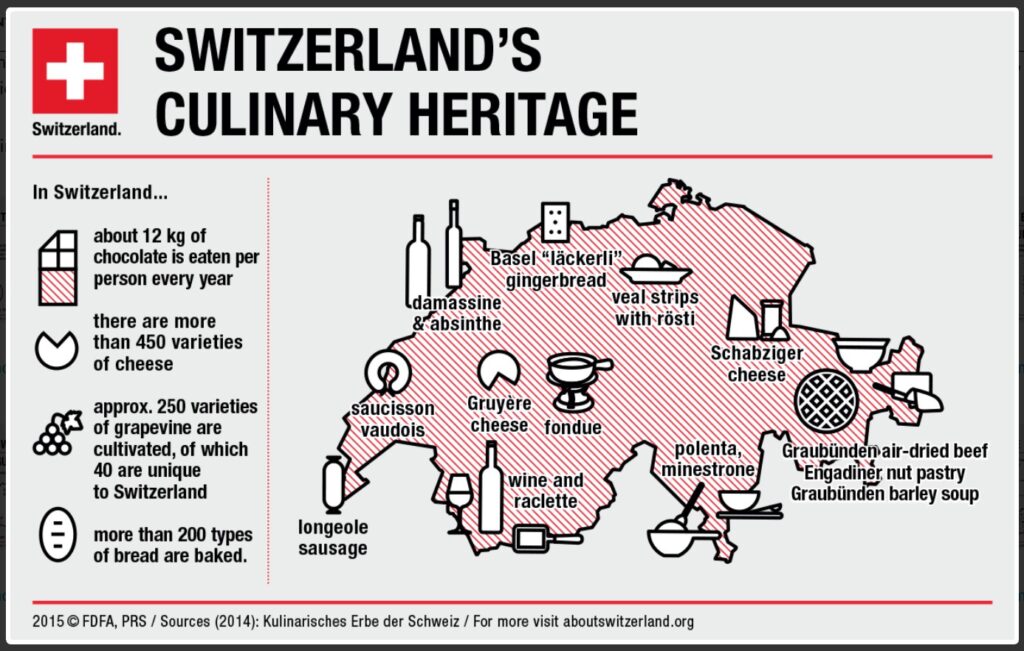
Swiss cuisine and the country’s food favourite owes its diversity and rich culinary heritage to its varied local traditions. Switzerland’s mountainous geograpy and the historically inaccessibility that comes with it have made that each region developed and produced its own specialities, some of which have now become national dishes. In addition, there are hundreds of types of cheese, meat products, bread and chocolate. Some Swiss-made food products are so popular they can be found in practically every Swiss household and on most tourist plates when they travel here with the Swiss cheese fondue being the most popular of them all.
Swiss Cuisine: Food favourites, fun facts, figures & fondue
To give you an impression about swiss cuisine, its eating traditions and food favourites we have gathered a long list of food fun facts, figures…and of course fondue!
Did you know that…
- There are 400 different Swiss products officially recognised as part of Switzerland’s culinary heritage. The most famous include Gruyère cheese (a favourite for fondue), longeole sausage and Basler Läckerli biscuits.
- No country in the world consumes as much chocolate as Switzerland – over 10kg per person each year. Luckily they are great sporty outdoor lovers otherwise the Swiss would have been fat.
- The Swiss also eat a lot of cheese – almost 22kg per person each year – and have over 450 types to choose from. Great source of yummy protein which includes their regular fondue meals.
- Fondue became the national dish of Switzerland when the Swiss Cheese Union aka the Swiss cheese maffia (Schweizer Käseunion) started campaigning fondue as a way to sell more cheese in the 1930s and get rid of their oversupply. The full unbelievable story of how this cheese conspiracy led to fondue becoming Switzerland’s national dish can be found:
- Switzerland is a melting pot of cultures (four languages spoken for example) so it seems more than fitting that its national dish fondue is a melting pot of flavors and aromas.
- There is a wide selection of bread, with more than 400 different types. Wholemeal bread is more popular in the German-speaking part of the country, while the French and Italian-speaking regions tend to prefer white bread. The traditional Swiss ‘Sunday bread’ is a buttery braided loaf.
- There is also a huge assortment of sausages, cold cuts and delicious dried meat specialities, which vary from region to region. In French-speaking Switzerland, for example, you’ll find Geneva’s longeole sausage, the saucisson vaudois and Jura’s boudin à la crème (blood sausage). Then there’s the St Galler Bratwurst (veal sausage) in the east of the country, Bündnerfleisch air-dried beef in the south-east, and liver mortadella from Ticino in the south.
- Switzerland’s national sausage is the cervelat, of which some 160 million are produced annually. It is traditionally grilled on a wooden skewer over an open fire, with a cross cut at both ends. You may even hear the Swiss talking about ‘cervelat celebrities’, a somewhat disparaging name they give local second-rate stars and influencers!
- Some 250 grape varieties are grown, of which around 40 are indigenous to Switzerland. The leading wine-making region is Valais, where over 50 different grape varieties are grown.
- Absinthe, otherwise known as the ‘green fairy’, is a wormwood schnapps distilled from various plants and originally produced as a medical elixir.
- Known today all over the world as a breakfast cereal, muesli was first created around 1900 by a Swiss doctor as an ‘apple diet food’ and served in clinics as a nutritious evening meal.
- Nestle, one of the largest food production companies in the world is from Switzerland and has its head office in Vevey at the lake of Geneva.
- Aromat powdered seasoning, invented by Knorr in 1952, is a staple on Swiss dining tables. The popular Maggi stock cubes have been around since 1908.
- Switzerland’s favourite bread spreads are Cenovis, a product launched in 1931 and made from brewer’s yeast, carrots and onions, and Le Parfait, which dates from 1942.
- Ovomaltine (known internationally as Ovaltine), that ‘different type of healthy hot-chocolate’, was developed in 1865 as a powder made from barley malt, skimmed milk and cocoa, to be mixed with milk as a chocolate beverage.
- Rivella is a soft drink produced from milk whey and has been on the market since the 1950s and can be declared Switzerland’s soft drink or Switzerland’s coca cola.
- Ricola is a cough drop made from 13 different herbs and has been produced since 1940 in and from Switzerland